Local SEO in Nepal: The Complete Guide for Small Businesses
Someone near your shop just searched for what you sell.
Google showed them three businesses. Yours wasn’t one of them.
That’s not bad luck. That’s local SEO, or the lack of it.
This local SEO in Nepal guide covers what actually works for a business in Nepal specifically. Not a generic guide written for Ohio and lightly edited. The real verification headaches, the real citation sources, and the real ranking factors, based on 2026 data.
Grab a coffee. This one is thorough.
- What Local SEO Actually Means
- The Real 2026 Ranking Factors, Not a Recycled List
- The Part Every Nepal-Specific Guide Should Start With: Verification
- Fixing the Address Problem Most Nepal Businesses Have
- NAP Consistency: The Nepal-Specific Trap
- Where to Actually List Your Business in Nepal
- Reviews: What Actually Moves the Needle in 2026
- On-Page Local SEO in Nepal and the Rising Importance of Schema
- Behavioral Signals: The Factor Most Nepal Businesses Ignore Completely
- Why Site Speed Matters Even More Here
- If You Have More Than One Location
- Mistakes I See Constantly
- A Realistic Local SEO Checklist
- Frequently Asked Questions
- Where This Leaves You
What Local SEO Actually Means
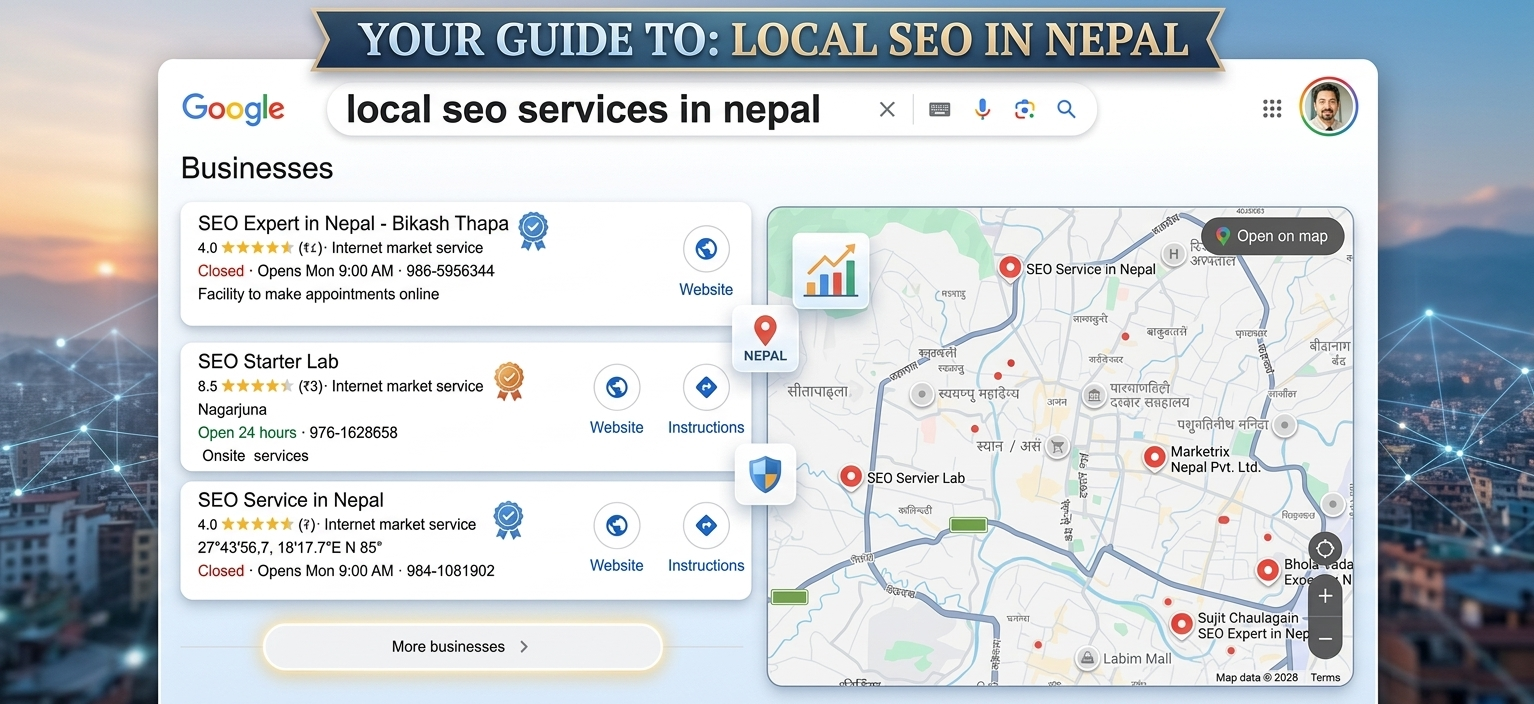
Local SEO is the work that gets your business shown when someone searches nearby. Think “seo expert in Nepal,” “dentist near me,” or “hotel in Pokhara.”
It runs on a different system than regular SEO. Google uses a separate local algorithm for the map pack, the block of three businesses with a map that appears above regular search results.
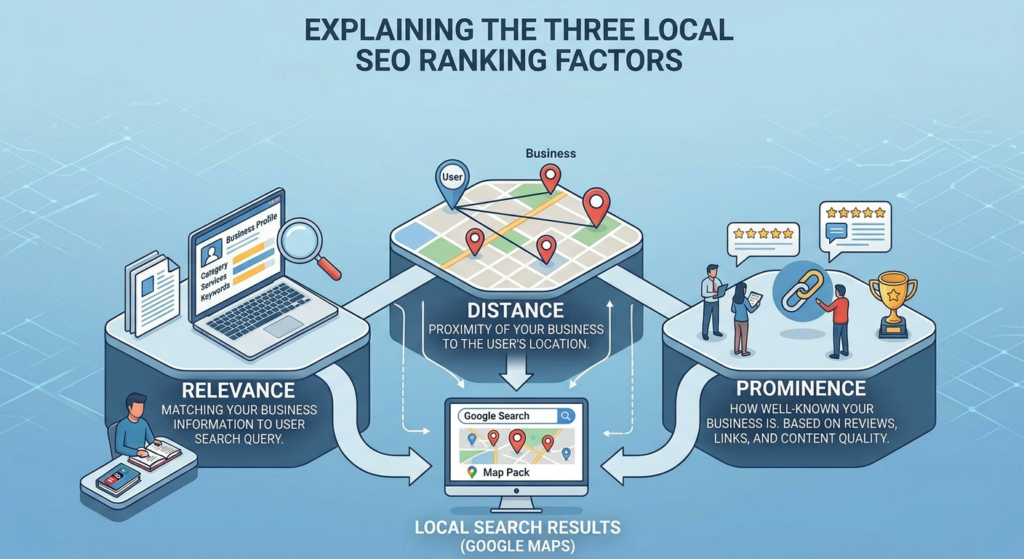
Three things decide who gets into that block: relevance, distance, and prominence. Everything else in this guide is really just a way of improving one of those three.
For businesses that want to go beyond the basics and improve their visibility across Google Search and Maps, I also provide local SEO services in Nepal, including Google Business Profile optimization, local keyword research, on-page SEO, and local search strategy. You can also check out other SEO services I provide.
The Real 2026 Ranking Factors, Not a Recycled List
Most local SEO articles list the same twenty factors with no sense of which ones matter. Here’s what current 2026 research actually shows.
BrightLocal’s 2026 Local Search Ranking Factors survey groups map pack signals into weighted categories. Google Business Profile signals carry the most weight, followed by reviews, then on-page factors, then behavioral signals, then links and citations.
Inside that, a few specific things stand out this year.
Your primary GBP category is the single strongest relevance signal. Not your website content. Not your business name. The category you pick when setting up your profile.
Review velocity now matters more than review count. A business getting two or three fresh reviews a month consistently outperforms one with two hundred old reviews and nothing recent.
Behavioral signals are the newest real factor. Google now tracks what people do after seeing your listing. Clicks to your website, calls, direction requests, and photo views all feed back into your ranking. A listing people ignore loses position, even if every other box is checked.
Citation volume has diminishing returns. Getting listed on your top 20 to 30 relevant directories helps. Chasing hundreds of low-quality directory listings beyond that does close to nothing for ranking, based on recent controlled testing.
Keep those four points in mind. They’ll save you from wasting time on the parts of local SEO that feel productive but aren’t.
The Part Every Nepal-Specific Guide Should Start With: Verification
Here’s something almost no global local SEO guide mentions, because it doesn’t apply anywhere else. Verifying a Google Business Profile in Nepal is genuinely harder than in most countries.
For years, the standard method was a physical postcard mailed to your business address with a verification code. In Nepal, that method has a real failure rate. Postal delivery to many addresses is unreliable, and business owners have reported waiting sixty, ninety, even a hundred and twenty days, repeatedly requesting a new postcard that never arrives.
As of 2026, Google has shifted most Nepal verifications toward video verification instead. You record a short video walkthrough of your business location using your phone, showing signage, the interior, and proof that the business is real and active. An automated system reviews it, often within three to five business days.
A few things improve your odds of the video getting approved on the first try:
- Make sure your business signage is clearly visible and matches the name on your profile exactly
- Film during business hours with visible activity, not an empty, closed shop
- Avoid a home address with no clear business setup unless your category specifically allows service-area businesses
Postcard verification hasn’t disappeared entirely. Some businesses, particularly in Kathmandu Valley, still receive one successfully within one to two weeks. But don’t count on it as your primary plan anymore.
One more thing worth knowing. If your profile ever gets suspended, do not delete it. A deleted, suspended profile can leave corrupted data attached to your address, making it harder to verify a fresh listing there later. File a reinstatement request instead and work through it properly.
Fixing the Address Problem Most Nepal Businesses Have
Most local SEO guides assume you have a clean, standard street address. Much of Nepal doesn’t work that way.
Formal, government-assigned street addresses are inconsistent outside a few areas. Businesses commonly rely on landmarks instead. Something like “New Road, Near Ratnapark, Opposite Nepal Bank” isn’t sloppy. It’s genuinely how people find your business in real life.
The fix isn’t to force an artificial formal address that doesn’t help anyone. It’s to be as specific and consistent as possible within that landmark-based system:
- Use the same landmark description everywhere, word for word
- Include the ward number if your municipality uses one
- Add a nearby, well-known reference point that a delivery driver or map app would recognize
Consistency matters more than formality here. Which brings us to the next section.
NAP Consistency: The Nepal-Specific Trap
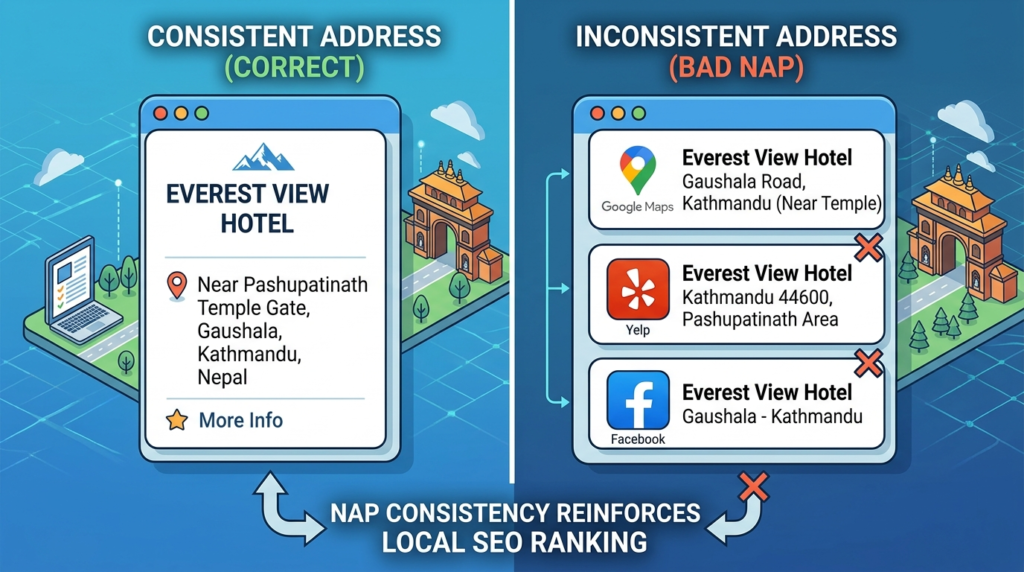
NAP stands for Name, Address, and Phone number. It needs to match exactly everywhere your business appears online: your website, your Google Business Profile, Facebook, and every directory listing.
Here’s the trap specific to Nepal. Abbreviating Kathmandu to “KTM” in one place and spelling it out in another</a> counts as an inconsistency to Google’s algorithm, even though a human reader wouldn’t blink at it.
The same applies to phone number formatting. Pick one format, +977 followed by your number with no spaces, for example, and use it identically everywhere. Don’t let one listing show a landline and another show a personal mobile number.
Run a simple audit every few months. Search your business name and check every result: your website footer, your Google Business Profile, your Facebook page, and any directory you’re listed on. Fix mismatches as you find them.
Where to Actually List Your Business in Nepal
Local citations are mentions of your business name, address, and phone number across the web, even without a link. They build the prominence Google uses to judge how established your business really is.
For a Nepal-based business, prioritize these first:
- Google Business Profile, obviously, and get it fully complete, not just created
- Facebook Business Page, since it functions as a de facto directory for most Nepali consumers
- LinkedIn Company Page, especially for B2B-facing businesses
- Apple Business Connect, increasingly relevant as more people search using Apple Maps
- Nepal Yellow Pages and other established Nepali business directories
Remember the earlier point about diminishing returns. Once you’ve covered your top twenty to thirty genuinely relevant listings, stop chasing volume. Put that time into reviews and content instead, where the actual ranking lift still exists.
Reviews: What Actually Moves the Needle in 2026
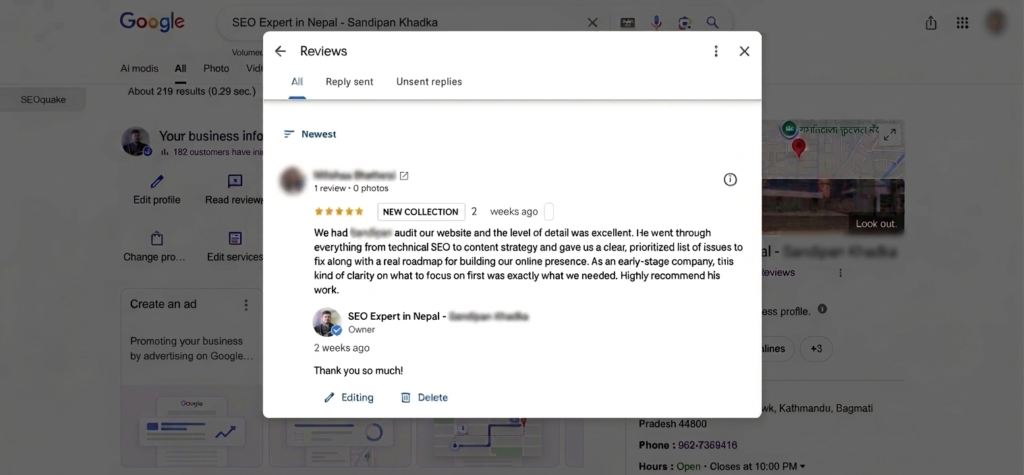
Reviews sit near the top of Google’s ranking weight for local businesses, and the details matter more than most business owners realize.
Total review count used to be the obsession. It isn’t anymore. Fresh, consistent reviews now carry more weight than a large pile of old ones. A business earning two or three genuine reviews a month steadily will often outrank a competitor sitting on two hundred reviews from three years ago.
Getting reviews from Nepali customers has a specific challenge. Leaving a Google review isn’t yet a strong cultural habit the way it is in some markets. Asking directly, at the right moment, matters more here than almost anywhere else.
A few approaches that work without breaking Google’s guidelines:
- Ask in person, right after a positive interaction, while the experience is fresh
- Send a direct WhatsApp message with a simple link, since WhatsApp is where most Nepali customers actually are
- Never offer a discount or incentive in exchange for a review. This violates Google’s policies and risks your entire profile
- Respond to every review, positive or negative, in plain, genuine language
Responding to reviews isn’t just good customer service. It’s itself a signal Google’s algorithm reads as an active, well-managed business.
On-Page Local SEO in Nepal and the Rising Importance of Schema
Your website still matters for local rankings, just less than your Business Profile does. A few specific things help:
- A dedicated page for each location if you operate in more than one city
- Your city or area name mentioned naturally in page titles and headers, not stuffed
- A clearly visible NAP block in your website footer, matching your GBP exactly
- LocalBusiness schema markup, which structures your address, hours, and category in a way search engines can read directly
That last point matters more in 2026 than it used to. Recent testing shows pages with clear, plain-language service descriptions and proper schema are increasingly getting cited inside AI-generated search summaries, not just ranking in traditional blue links. That citation appears to give a real, measurable lift to local pack position for a period afterward.
In plain terms: writing your services in clear language and marking them up with schema so machines can read them easily now helps in two places at once, not just one.
Behavioral Signals: The Factor Most Nepal Businesses Ignore Completely
This is genuinely new, and almost no Nepal-focused guide covers it yet.
Google now tracks what happens after someone sees your listing. Do they click through to your website? Call you? Request directions? View your photos? A listing that gets engagement holds and improves its position. One that gets ignored loses ground over time, regardless of how complete the profile looks on paper.
Practical ways to improve this:
- Keep your hours genuinely accurate, since incorrect hours cause people to bounce off your listing without acting
- Upload real, current photos regularly rather than a handful uploaded once at setup
- Make sure your phone number is a working line someone actually answers, not a disconnected landline
- Keep your website fast and mobile-friendly, since a slow site kills the click-through this signal depends on
Why Site Speed Matters Even More Here
Core Web Vitals affect both organic and local rankings. This matters more in Nepal specifically, because average internet speeds here still run below the global average.
A site that loads acceptably fast on a strong connection abroad can feel painfully slow on a typical mobile connection in much of Nepal. That gap costs you both rankings and the behavioral signals covered above, since a slow site is a site people bounce from.
Practical fixes: compress images properly, avoid heavy unnecessary JavaScript, and use a content delivery network if your hosting doesn’t already include one. None of this is exotic. It’s just easy to neglect.
If You Have More Than One Location
Multi-location businesses in Nepal, a clinic with branches in Kathmandu and Pokhara, for example, need a separate, fully verified Google Business Profile for each physical location. Trying to rank one profile for multiple cities doesn’t work and can trigger a suspension for guideline violations.
Each location needs its own dedicated page on your website too, with genuinely different content, not a copy-pasted template with the city name swapped out. Google can tell the difference, and so can your customers.
Mistakes I See Constantly
A few patterns repeat often enough to call out directly.
Choosing the wrong primary category to seem more impressive. A specific, accurate category beats a broad, ambitious one every time. “Trekking Agency” outperforms “Travel Company” if trekking is genuinely your core business.
Treating GBP setup as a one-time task. Profiles need regular updates: new photos, accurate hours, responses to reviews. An abandoned profile quietly loses ground month after month.
Panicking and deleting a suspended profile. As covered above, this makes recovery harder, not easier.
Ignoring the website entirely because “GBP is what matters.” GBP carries the most weight, but a slow, thin website still drags down both organic and local performance.
A Realistic Local SEO Checklist
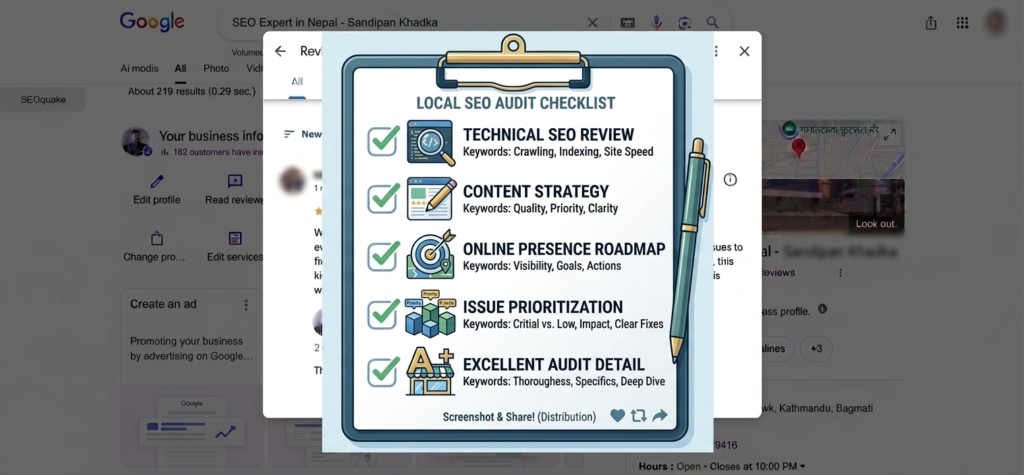
If you only do five things after reading this, make it these:
- Choose the single most accurate GBP category, not the most impressive-sounding one
- Get your NAP identical across your website, GBP, Facebook, and every directory
- Ask for reviews consistently, a few a month, rather than a rushed batch once
- Add LocalBusiness schema to your website
- Check your site loads quickly on an average Nepali mobile connection, not just your office wifi
Frequently Asked Questions
How long does Google Business Profile verification take in Nepal?
Video verification, now the primary method for most Nepal businesses, typically takes three to five business days for review. Postcard verification, where still offered, can take one to three weeks depending on your location.
What if my business doesn’t have a formal street address?
Use a clear, consistent landmark-based description instead, the same way you’d describe your location to a customer in person. Consistency across every platform matters more than having a formal-looking address.
How many Google reviews do I need to rank well?
There’s no fixed number. Consistent, fresh reviews arriving regularly matter more than a large total count. A steady two or three genuine reviews a month is more valuable than two hundred reviews with none in the last year.
Should I list my business on every directory I can find?
No. Prioritize the twenty to thirty directories genuinely relevant to your industry and location. Beyond that, additional citations show little measurable ranking benefit and aren’t worth the time.
Does my website really matter if my Google Business Profile is strong?
Yes, though less than the profile itself. A slow or thin website drags down both your local and organic rankings, and increasingly affects whether your content gets cited in AI-generated search summaries.
Where This Leaves You
Local SEO in Nepal isn’t the same job as local SEO anywhere else. The verification process is different. The addressing system is different. The review culture is different.
Most guides ignore all of that because they’re written for a different country and lightly reworded. Everything above is written from actually doing this work here.
Start with your Business Profile category and your NAP consistency. Those two things alone fix more ranking problems than anything else on this list.